Free for schools in Buckinghamshire, Hertfordshire, Berkshire and Bedfordshire · 2026/27

A free sports assessment at your child’s school

We measure how fast, how high and how powerfully children move — using a portable radar on the school field. No cameras, and no sensor worn by your child. Every child gets their own numbers and a personal certificate to take home.

One class · 60 minutes No cost to the school We bring everything
Request an assessment

Takes 30 seconds. Tell us your school and we’ll approach them for you.
Available to schools in Buckinghamshire, Hertfordshire, Berkshire and Bedfordshire while places last.

Every child gets a number, not just the fastest one

In a normal PE lesson, the quickest child is obvious and everyone else is a blur. Nobody goes home knowing how fast they actually ran, or whether they are getting better.

We change that. A portable radar sensor on the sideline measures each child as they sprint, jump, throw and kick — and turns it into their own set of numbers. Not a ranking. A personal baseline, and something to beat next time.

Children develop at very different rates, and at primary age the difference between two children in the same class can be enormous and entirely normal. Measuring gives every child something that is genuinely theirs to improve, rather than a race they were never going to win.

A Sports Vectors radar unit on a tripod at the edge of a school playground, with children on the court in front of it.
The whole system: one small radar unit on a tripod at the edge of the court. It measures from a distance, and there is no camera.

Four activities, one hour

Sprint speed

Top speed over a short run, measured continuously rather than with a stopwatch.

Agility

Stopping, starting and changing direction at speed, through a slalom course.

Throw

Release speed and distance.

Kick

Ball speed and accuracy at a target.

One class, or the whole school

Whole school

Every year group

3 hours

We run continuously through a morning or afternoon and classes come to us in turn. The school gets a picture across every year group — useful for sports day, for tracking a cohort, or simply for something to show at parents’ evening.

Progress, or comparison — the school chooses

Every certificate shows the child’s own measurements. Beyond that there are two ways to read them, and the school decides which is used.

Option one

Their own progress

No comparison with anyone

Just the child’s numbers, and how they have changed since the last visit. Nothing about anybody else appears on the certificate. This is the default if a school would rather keep it that way.

The month-of-birth comparison matters more than it sounds. Within one school year a child born in September can be almost a year older than one born the following August, and at primary age that gap is enormous. Measured against their whole year group, summer-born children look slower and weaker than they are — and they get quietly written off for it, in team selection and in their own heads. Comparing a child with others born in the same month takes that distortion out.

Dots on a screen, not pictures of children

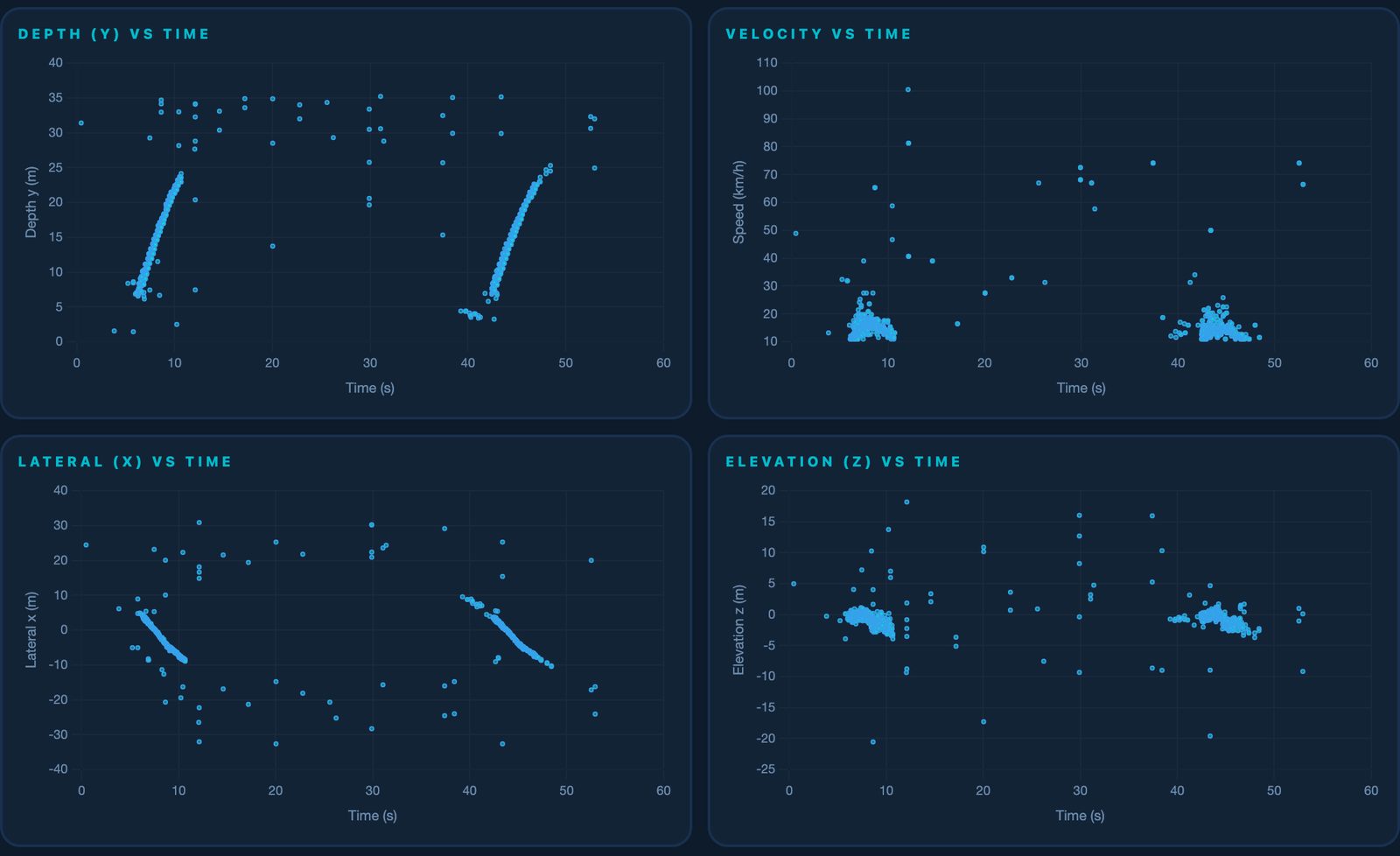
The radar has no camera and takes no photographs. What it produces is a point cloud — a moving cluster of dots, each one a reflection from something in front of the sensor. A running child appears as a shifting group of dots, and nothing more.

From the way that cluster moves we work out speed, distance, height and direction. There is no image, no video, no face, and no feature that could identify anybody. If you looked at our raw data, you would see dots.

Four scatter charts of radar point-cloud data from a sprint: depth, velocity, lateral position and elevation against time.
Real data from a single sprint. Depth, speed, sideways position and height — every dot a radar reflection. This is what we hold: a cluster of measurements, with no picture of anybody.

And we do not know which child is which. On the day, children are measured as numbers rather than names — a numbered bib or wristband is how we tell one run from the next. The school holds the list of which number belongs to which child, and keeps it. Our records are measurements against a number — the school keeps the key, and it stays with them.

Nothing for staff to organise

We’re building the baseline, and we’d rather say so

There is a catch, and this is it. To tell a child how they compare with others their age, somebody has to have measured enough children to know. That reference data does not really exist for primary-age children in this country — so we are building it.

Today the ranges we compare against come from a model rather than from measured children. Every school we visit makes them more real. We would rather explain that than imply a precision we do not yet have.

So that is the trade. Your child’s school gets the assessment and every child gets a certificate, at no cost. We get anonymous, aggregate measurements that improve the baseline for every child measured after them. No names and no personal details form any part of that reference data.

As the dataset grows the comparisons get sharper — and we send updates to every school that has taken part, so the schools that helped build it are the first to benefit from it.

Tell us your school and we’ll do the rest

You don’t need to speak to anyone at the school. Leave us your details and the school’s name, and we will send them the information pack and arrange it directly — mentioning that a parent asked us to get in touch.

So we can tell you what the school says.
Helps us find the right school — there are a lot of St Mary’s.

The offer in detail. Free assessments are available to schools in Buckinghamshire, Hertfordshire, Berkshire and Bedfordshire during the 2026/27 academic year, subject to availability and to our schedule. We can only take a limited number of schools each term, and we reserve the right to decline a request or to withdraw the offer at any time. There is no cost to the school and no obligation to purchase anything afterwards.

We only collect your name, email and your school’s details — never any information about your child. We use them to contact your school and to let you know the outcome, and nothing else. See our privacy policy.

The things parents ask

Is it really free?

Yes — no cost, and no obligation to buy anything afterwards. We are doing it because we need the data: the age-by-age reference ranges that make a child’s result meaningful do not yet exist for primary-age children, and every school we visit helps build them. The measurements we keep for that purpose are anonymous and aggregate, with no child’s name or personal details attached.

Does my child need to be sporty?

No. Every child gets their own numbers, whatever those numbers are. Nothing is published and there is no team selection. If the school prefers, the certificate shows a child’s own progress with no comparison at all. Children who dread being picked last tend to enjoy this most, because they are measured against themselves.

Are the children ranked against each other?

Not against their classmates. Where a school opts in, the certificate shows how a child compares with a reference range for their school year and for their month of birth — not a position in the class. We never produce or publish a class league table, and the school can turn the comparison off entirely.

Which areas do you cover?

We are offering free assessments to schools in Buckinghamshire, Hertfordshire, Berkshire and Bedfordshire during the 2026/27 academic year.

Travelling to a school is most of what a session costs us, so we prioritise places where several schools want to take part at the same time. If you know parents at other schools nearby, pointing them at this page genuinely helps — a cluster of schools in one area is far easier for us to reach than a single school on its own.

If your school is outside the area, send the form anyway and we will let you know when we can get to you.

Does my child have to wear anything?

Nothing that measures or records anything. The radar does all the measuring from the sideline, and no sensor is attached to your child. Children may be given a numbered hi-viz bib or a silicone wristband so we can tell which run belongs to which number — these carry a number and nothing else. No battery, nothing recorded, nothing tracked, and they are handed back at the end.

What happens to the measurements?

Results are shared with the school and with each child on their certificate. We do not publish individual results or pass them to anyone else. The school remains in control of any information about its pupils, and we agree the arrangements with them in writing before we visit.

What do you need from the school?

A field, playground or hall for the session, and a member of staff present throughout. That is all — we bring and set up everything else.

How long does it take to arrange?

We contact the school within a few days of your request. Most schools want to look at the information pack and find a slot in the PE timetable, so it is usually a few weeks from first contact to the visit.